Defining System Insight
Observability is the measure of how well you can understand the internal state of a system based solely on its external outputs. While monitoring tells you that a service is down, observability explains why it failed, even if the specific failure mode has never been seen before. It transforms telemetry into actionable intelligence for DevOps and SRE teams.
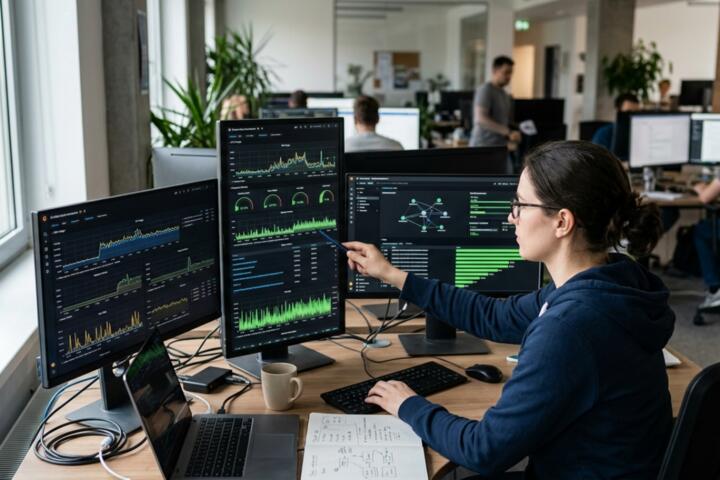
In a monolithic era, a simple dashboard showing CPU and RAM was often sufficient. Today, a single user request might traverse 50 different microservices. If that request takes 5 seconds instead of 200ms, monitoring might show all systems are "green," but observability reveals a latent lock contention in a specific database shard.
Data from the DORA (DevOps Research and Assessment) report indicates that elite performers—those with high observability maturity—are 4.1 times more likely to have lower change failure rates. Furthermore, companies using advanced tracing reduce their Mean Time to Recovery (MTTR) by up to 50% compared to those relying on logs alone.
The Three Pillars of Telemetry
The foundation rests on logs, metrics, and traces. Logs provide the "what" (event details), metrics provide the "how many" (aggregates over time), and traces provide the "where" (the journey of a request). Integrating these into a unified data model is the first step toward true visibility.
High Cardinality and Dimensionality
Modern observability thrives on high cardinality—the ability to track unique identifiers like UserID or OrderID. Unlike traditional metrics that aggregate data, high-cardinality data allows you to pivot and filter logs to find the specific "needle in the haystack" affecting a single customer.
Contextual Metadata Enrichment
Every piece of telemetry should be enriched with environmental metadata. This includes the container ID, the specific git commit hash, and the region. This context allows developers to correlate a spike in error rates directly to a specific deployment or infrastructure change.
Open Standards and Portability
Vendor lock-in is a significant risk in this space. Adopting OpenTelemetry (OTel) has become the industry standard. OTel provides a neutral framework for collecting and exporting data to various backends, ensuring your instrumentation remains valid even if you switch providers.
The Concept of Exploratory Analysis
Observability assumes you don't know what questions you'll need to ask in the future. It requires a data store capable of handling unstructured queries at scale, allowing engineers to test hypotheses in real-time during a production incident without pre-configured dashboards.
Common Visibility Gaps
The most frequent mistake is treating observability as "more monitoring." Teams often drown in data but starve for information. They collect billions of logs but lack the correlation IDs necessary to link them together, resulting in "siloed" telemetry that provides no clear narrative during an outage.
Alert fatigue is a direct consequence of poor strategy. When engineers receive 50 notifications for a single downstream service failure, the signal-to-noise ratio collapses. This leads to burnout and missed critical events. Without proper tracing, teams spend hours in "war rooms" guessing which service is the root cause.
Another pain point is the "Observer Effect," where the cost of collecting telemetry degrades system performance. Poorly implemented tracing can add significant latency to requests or balloon cloud egress costs. Without a sampling strategy, companies often find their observability bill rivaling their primary infrastructure spend.
Strategic Implementation
Start by implementing Distributed Tracing using tools like Jaeger or Honeycomb. Tracing allows you to visualize the entire lifecycle of a request across service boundaries. By assigning a unique Trace ID at the load balancer level, you can follow a request through every database call and third-party API interaction.
Shift your focus from system metrics to Service Level Objectives (SLOs). Instead of alerting on "CPU > 80%," alert on "99th percentile latency > 500ms for 5 minutes." This aligns technical performance with user experience, ensuring engineering efforts are directed toward issues that actually impact the business.
Automate your instrumentation. Use eBPF-based tools like Pixie or Groundcover to gain kernel-level visibility without modifying your application code. This provides instant insights into network throughput and system calls with minimal overhead, filling gaps in legacy applications that are difficult to instrument manually.
Implement structured logging in JSON format. Traditional text logs are difficult for machines to parse efficiently. Structured logs allow platforms like Datadog or New Relic to index fields automatically, enabling sub-second searches across petabytes of data during a critical P0 incident.
Standardizing the OTel Collector
Deploying an OpenTelemetry Collector as a sidecar or gateway is a high-impact move. It allows you to process, filter, and mask sensitive PII (Personally Identifiable Information) before it leaves your network. This reduces data volume by filtering out "heartbeat" logs while ensuring compliance with GDPR and SOC2.
Leveraging Real User Monitoring (RUM)
Backend visibility is only half the story. Tools like Sentry or LogRocket capture the "frontend" experience. By correlating frontend errors with backend traces, you can see that a 404 error in the browser was actually caused by a timeout in a specific microservice, drastically shortening the debugging loop.
Implementing Tail-Based Sampling
Instead of keeping 100% of traces (which is expensive) or 1% at random (which misses errors), use tail-based sampling. This method keeps 100% of traces that result in an error or high latency, while discarding mundane successful traces. This optimizes storage costs while retaining every "interesting" event.
Adopting Error Budgets
Error budgets quantify the amount of downtime your service can tolerate. If a team exhausts their budget due to poor stability, new feature releases are paused in favor of reliability work. This creates a balanced incentive structure between "speed to market" and "system health."
Utilizing AIOps for Noise Reduction
Modern platforms use machine learning to group related alerts into a single "incident." For example, if a database goes down, AIOps can suppress the 200 secondary "connection refused" alerts from dependent services, presenting the responder with one clear root cause to investigate.
Real-World Transformations
A major e-commerce platform faced 30-minute outages during peak sales because they couldn't identify which third-party payment gateway was failing. By implementing distributed tracing and high-cardinality tagging, they identified a specific regional API timeout. MTTR dropped from 35 minutes to 4 minutes, saving an estimated $200,000 per incident.
A fintech startup struggled with "intermittent" transaction failures. Standard logs showed nothing wrong. After deploying OpenTelemetry and analyzing span attributes, they discovered a race condition that only occurred when three specific microservices interacted under high load. The issue, which persisted for months, was solved in two days once the execution flow was visualized.
Tooling and Strategy Matrix
| Category | Standard Tools | Core Benefit | Ideal Use Case |
|---|---|---|---|
| Open Source Stack | Prometheus, Grafana, Jaeger | No licensing fees, total control | Teams with high DevOps expertise |
| Managed Platforms | Datadog, New Relic, Dynatrace | Turnkey integration, AI insights | Enterprise-scale, complex ecosystems |
| Developer-Centric | Honeycomb, Lightstep | Deep dive into high cardinality | Debugging complex distributed bugs |
| Log Aggregation | Elasticsearch, Splunk, Loki | Powerful text search and audit | Compliance and historical forensics |
Preventing Common Failures
Avoid the "Dashboard Graveyard." Many teams create hundreds of dashboards that no one looks at. Instead, build dashboards based on "The Golden Signals": Latency, Traffic, Errors, and Saturation. If a graph doesn't help you make a decision during an outage, delete it to reduce cognitive load.
Do not ignore the cost of data ingestion. Many SaaS observability tools charge per GB. Without a clear retention policy (e.g., 7 days for debug logs, 30 days for traces, 1 year for metrics), your observability costs can easily exceed your actual compute costs. Use "log levels" dynamically to increase verbosity only during incidents.
Frequently Asked Questions
Is observability only for microservices?
No. While microservices benefit most due to their complexity, monoliths also benefit from structured logging and tracing to identify slow database queries or memory leaks within the application process.
How does observability differ from monitoring?
Monitoring is reactive and answers "is it broken?" Observability is proactive and answers "why is it behaving this way?" Monitoring uses predefined thresholds; observability allows for open-ended exploration of data.
What is the biggest challenge in adoption?
The challenge is rarely technical; it is cultural. It requires moving away from a "blame culture" toward a data-driven approach where developers take responsibility for the operability of their code in production.
Can I use OpenTelemetry with legacy systems?
Yes. OTel provides SDKs for most languages, including Java, C++, and .NET. For systems that cannot be modified, eBPF-based agents can collect network and system telemetry without code changes.
Does more data mean better observability?
Often, the opposite is true. Excess data creates noise. The goal is "High-Quality" data—telemetry that is linked, contextualized, and mapped to business outcomes rather than just raw volume.
Author’s Insight
In my experience overseeing large-scale migrations, the most successful teams are those that treat observability as a "first-class citizen" in the development lifecycle. It isn't a task for the end of a sprint; it’s an architectural requirement. When you give a developer a trace that perfectly visualizes their code’s failure, the "aha!" moment changes their coding habits forever. My advice: don't boil the ocean—start by tracing your most critical business transaction and expand from there.
Conclusion
Transitioning to an observability-driven culture is the only way to manage the inherent complexity of modern software. By prioritizing high-cardinality data, adopting open standards like OpenTelemetry, and focusing on Service Level Objectives, organizations can move from firefighting to strategic scaling. Start by auditing your current telemetry gaps and implement distributed tracing on a single high-traffic service today to see immediate ROI in your incident response efficiency.