The Evolution of Care
In the traditional industrial landscape, maintenance followed a calendar. You changed the oil every six months regardless of whether the machine ran for ten hours or a thousand. Predictive maintenance (PdM) flips this script by monitoring the actual physiological state of the machine. It is the difference between getting a physical every year and wearing a heart monitor that alerts your doctor the moment an arrhythmia is detected.
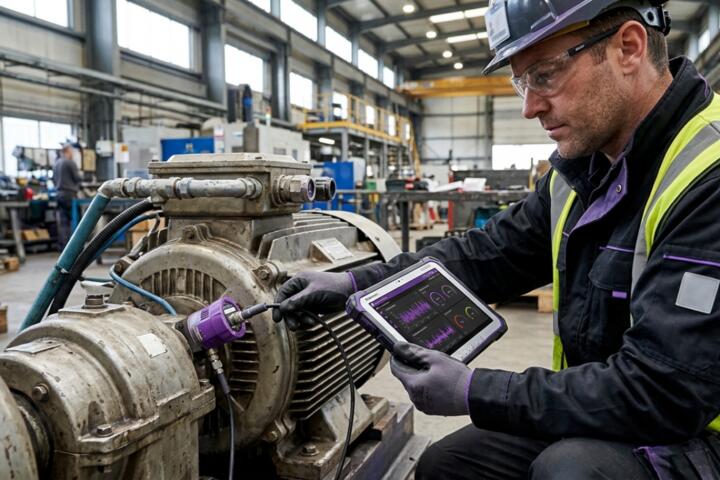
Consider a high-speed bottling line in a beverage plant. A microscopic misalignment in a bearing might be undetectable to a human ear, but a high-frequency vibration sensor picks it up instantly. Systems like IBM Maximo or SAP Asset Intelligence Network ingest this data, compare it against historical failure patterns, and issue a work order weeks before the bearing actually seizes.
The financial impact is quantifiable. According to a Deloitte study, PdM can increase equipment uptime by 10–20% and reduce overall maintenance costs by 5–10%. In the energy sector, Shell has reported using AI-driven predictive models to monitor thousands of valves and pumps, preventing millions of dollars in potential lost production by catching "silent killers" in the infrastructure.
The Role of IoT Integration
The backbone of any modern service is the Internet of Things (IoT). Sensors measuring parameters like tri-axial vibration, ultrasonic noise, and thermography are the "eyes and ears" of the system. Without high-fidelity data, the most advanced AI is useless.
Machine Learning in Action
Algorithms don't just look for thresholds; they look for trends. If a motor's temperature rises by 2 degrees every Tuesday, a standard alarm won't trip, but a predictive model will flag this as an anomaly related to specific load cycles.
Edge vs Cloud Analytics
Speed matters. Services often utilize edge computing—processing data directly on the sensor or a local gateway—to provide millisecond-response times for critical shut-offs, while the cloud handles long-term trend analysis and fleet-wide benchmarking.
Digital Twin Simulation
Advanced services create a "Digital Twin," a virtual replica of the physical asset. By running simulations on the twin, engineers can predict how a pump will behave under extreme pressure without risking the actual hardware.
Acoustic Leak Detection
In pressurized systems, specialized microphones can hear the "hiss" of a leak at frequencies far beyond human capability. This allows for the repair of air or gas leaks that would otherwise waste thousands of kilowatt-hours of energy annually.
Common Industry Pitfalls
The most frequent mistake companies make is "data hoarding" without a strategy. They install thousands of sensors but lack the analytical framework to interpret the output. This leads to "alarm fatigue," where maintenance teams begin ignoring alerts because 90% of them are false positives or irrelevant noise.
Another critical failure is the lack of integration between the data science team and the shop floor. If an algorithm says a CNC machine will fail in 40 hours, but the floor manager doesn't trust the data, the machine will run until it breaks. This cultural resistance often negates the entire investment in technology.
Finally, many firms ignore the "P-F Interval"—the time between when a potential failure is detected and when the functional failure occurs. If your predictive service only gives you a two-hour warning for a part that takes two days to ship, the service hasn't actually solved the problem of downtime.
Strategic Implementation
To succeed, start with a "Criticality Analysis." Not every motor needs a $500 sensor. Map your assets based on how much a failure costs per hour. A primary turbine needs 24/7 monitoring; a localized exhaust fan might just need a monthly handheld check.
Implement a tiered sensor approach. Use low-cost, battery-powered Bluetooth sensors for general health monitoring and high-fidelity wired sensors for your "Tier 1" production-critical machinery. This optimizes your CAPEX while maintaining high coverage.
Utilize specialized platforms like GE Digital’s APM or Honeywell Forge. These tools don't just show graphs; they provide "Prescriptive Maintenance." They tell you not just *when* it will fail, but *how* to fix it, including the specific parts and tools required for the technician.
The results of this focused approach are staggering. A mid-sized manufacturing facility using Augury’s vibration sensors reported a 4x Return on Investment (ROI) within the first year. By preventing just two catastrophic gearbox failures, the system paid for its entire five-year subscription fee.
Focus on Vibration Analysis
Vibration is the gold standard for rotating equipment. By analyzing the Fast Fourier Transform (FFT) spectrum, services can distinguish between a loose bolt, a bent shaft, or an inner-race bearing defect with nearly 100% accuracy.
Oil Analysis Automation
Instead of manual sampling, use in-line oil sensors that monitor metallic debris, viscosity, and moisture. This is vital for heavy machinery where oil contamination is the leading cause of hydraulic failure.
Thermal Imaging Reliability
Infrared thermography identifies "hot spots" in electrical panels and transformers. Catching a loose connection before it arcs can prevent devastating industrial fires and weeks of power-related outages.
Integrating CMMS Data
Connect your predictive alerts directly to your Computerized Maintenance Management System (CMMS) like Fiix or UpKeep. This automates the creation of work orders, ensuring the prediction leads to a physical action.
Workforce Upskilling
The best tool is only as good as the operator. Invest in training your technicians to interpret sensor data. A "connected worker" with a tablet can see real-time diagnostics while standing next to the machine, making them vastly more efficient.
Real-World Success Stories
A major North American pulp and paper mill faced recurring issues with its drying rollers. Each unplanned stop cost roughly $25,000 per hour. They implemented an AI-based vibration monitoring service across 150 critical points. Within three months, the system identified a bearing cage failure in its early stages. The mill scheduled a 4-hour repair during a holiday weekend. Analysis showed that had the roller seized during production, it would have caused $400,000 in lost revenue and equipment damage.
In the commercial aviation sector, Airbus uses its Skywise platform to aggregate data from thousands of aircraft. One airline partner used the service to predict hydraulic pump failures. By replacing pumps "on condition" rather than on a fixed schedule, they reduced technical delays by 15% and saved millions in emergency logistical costs for grounded aircraft (AOG situations).
Tool and Service Comparison
| Service/Platform | Core Strength | Target Industry | Key Feature |
|---|---|---|---|
| IBM Maximo | Enterprise Integration | Manufacturing/Utilities | Advanced AI & Asset Lifecycle |
| Augury | End-to-End Hardware | Food & Bev / Pharma | High-accuracy vibration AI |
| Uptake | Heavy Equipment Data | Mining / Construction | Pre-built failure models |
| Siemens Senseye | Automated Diagnostics | Automotive / Heavy Ind. | No data scientist required |
| AWS Monitron | Scalability / Cost | General Industrial | Easy DIY sensor deployment |
Navigating Deployment Risks
Avoid the "Pilot Purgatory" trap. Many companies start a small trial but never scale because they didn't define what success looks like. Set clear KPIs: Reduction in Mean Time to Repair (MTTR) or an increase in Mean Time Between Failures (MTBF).
Don't ignore the network. Industrial environments are notoriously difficult for Wi-Fi. Ensure your predictive service provider supports cellular (LTE/5G) or LoRaWAN protocols to ensure data reaches the cloud reliably from the basement of a factory.
Lastly, beware of "Black Box" AI. If a service tells you to shut down a machine but won't explain why, your engineers will lose trust. Demand "Explainable AI" that shows which specific data points (e.g., a spike in the 2nd harmonic of motor speed) triggered the alert.
FAQ
Is PdM too expensive for small plants?
No. With "Maintenance as a Service" (MaaS) models and low-cost sensors like AWS Monitron, small facilities can start monitoring critical assets for a few hundred dollars a month without heavy upfront CAPEX.
How long does it take to see an ROI?
Typically, ROI is achieved within 6 to 18 months. The first time the system prevents a catastrophic failure of a lead-time-heavy component, the system usually pays for itself instantly.
Does this replace my maintenance team?
Absolutely not. It empowers them. It shifts their workload from emergency "firefighting" to planned, precision maintenance, which is safer and less stressful for the staff.
What is the difference between PdM and CBM?
Condition-Based Maintenance (CBM) looks at the current state (is it hot?). Predictive Maintenance (PdM) uses that state plus historical data to forecast the future (when will it break?).
Can PdM work on old "dumb" machinery?
Yes. You can "bolt-on" intelligence by adding external vibration and temperature sensors to 30-year-old pumps, effectively bringing them into the digital age.
Author’s Insight
Having overseen the digital transformation of several mid-sized manufacturing hubs, I’ve seen that the biggest hurdle isn't the technology—it's the mindset. I always tell clients to stop looking at predictive maintenance as an IT project; it’s an operational philosophy. My best advice is to start small: pick your most "annoying" machine—the one that breaks the most—and prove the value there first. Once the shop floor sees a win, the momentum for a full-scale rollout becomes unstoppable.
Conclusion
Moving toward a predictive model is no longer a luxury for industrial leaders; it is a competitive necessity. By focusing on high-quality data, choosing the right analytical tools, and fostering a culture of trust between man and machine, organizations can virtually eliminate the "unexpected." Start by identifying your critical failure points and deploying targeted sensor solutions. The goal is simple: stop fixing things that aren't broken, and start fixing things before they do.