Beyond Uptime: Redefining Operational Resilience
Resilience in service delivery is no longer just about avoiding a "404 Error" or keeping the lights on. It is the structural capacity of an organization to absorb shock, adapt to shifting demands, and maintain continuous value flow. While traditional frameworks focus on disaster recovery, a modern resilient framework integrates "Chaos Engineering" principles into the daily workflow.
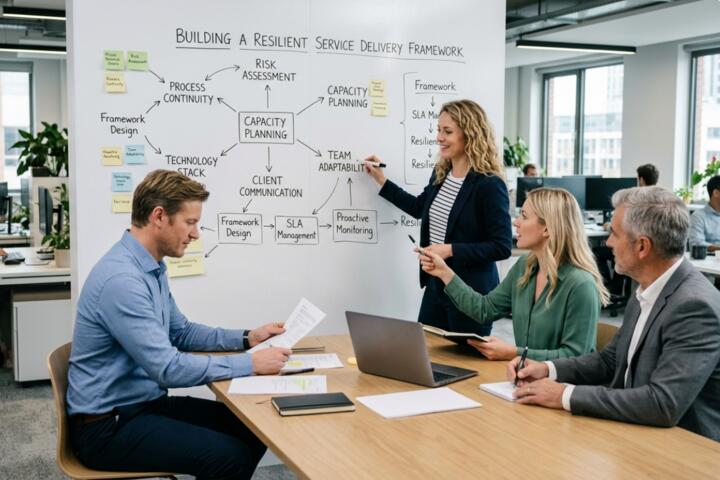
Consider a global fintech provider like Stripe. Their resilience isn't just about server redundancy; it’s about their API’s ability to handle massive traffic spikes during Black Friday without manual intervention. In practice, this means moving from monolithic architectures to decoupled microservices where the failure of one component—like a notification engine—doesn't crash the entire checkout process.
Data from Uptime Institute indicates that nearly 70% of all data center outages are due to human error rather than hardware failure. Furthermore, the cost of high-level outages now frequently exceeds $100,000 per hour. Resilience, therefore, is as much about human governance and automated guardrails as it is about software code.
The Fragility Trap: Why Current Systems Fail
Many organizations fall into the "Static Stability" trap. They build systems that are strong but brittle, much like a glass pillar that holds immense weight but shatters under a sudden sideways impact. The most common mistake is over-reliance on manual intervention for scaling and recovery, which creates bottlenecks during high-stress events.
Legacy debt is another primary pain point. Teams often prioritize "Feature Velocity" over "Reliability Engineering," leading to a scenario where 40% of developer time is spent on unplanned work or bug fixes. This technical debt acts as high-interest credit; eventually, the system becomes too expensive to maintain, and service delivery grinds to a halt.
We see this frequently in the healthcare sector. When a legacy patient management system is integrated with modern mobile apps without a resilient middleware layer, any update to the app can trigger a cascade of failures in the core database. The consequence isn't just lost revenue; it’s a loss of trust that can take years to rebuild.
Strategic Pillars for a Hardened Delivery Framework
Decoupling Services via Asynchronous Architecture
To build resilience, you must eliminate single points of failure. Moving from synchronous requests to asynchronous message brokers like Apache Kafka or RabbitMQ allows systems to process data at their own pace. If a downstream service goes offline, the message remains in the queue, preventing data loss and allowing the system to "self-heal" once connectivity is restored. This approach can reduce system-wide crashes by up to 65% in high-load environments.
Implementing "Circuit Breaker" Patterns
Borrowed from electrical engineering, the Circuit Breaker pattern prevents a failing service from repeatedly trying to execute an operation that is likely to fail. Tools like Resilience4j or Hystrix allow you to define thresholds. If a service call fails more than 15% of the time, the circuit "opens," and the system immediately returns a fallback response or a cached value. This prevents the "retry storm" that often crashes entire networks during a minor outage.
The "Observability" Over "Monitoring" Shift
Monitoring tells you when something is broken; observability tells you why it broke. Implementing a full-stack observability suite using Datadog, New Relic, or Grafana enables teams to trace a single request through ten different microservices. By analyzing high-cardinality data, organizations can identify "silent failures"—performance bottlenecks that don't trigger an alarm but degrade user experience and conversion rates.
Automated Infrastructure as Code (IaC)
Resilience requires the ability to recreate your entire environment from scratch in minutes, not days. Using Terraform or AWS CloudFormation, infrastructure becomes version-controlled code. This eliminates "configuration drift," where small manual changes over time make the production environment different from staging. Companies using IaC report 4x faster recovery times (MTTR) because they can simply redeploy a known-good configuration rather than troubleshooting a "snowflake" server.
Chaos Engineering and Stress Injection
True resilience is earned through controlled destruction. Using tools like Gremlin or AWS Fault Injection Simulator, teams intentionally introduce latency or shut down instances in production. This verifies that your automated failovers actually work. Netflix’s Chaos Monkey is the gold standard here; by constantly breaking things during business hours, they ensure their engineers build systems that are inherently fault-tolerant.
Service Level Objectives (SLOs) with Teeth
Standard SLAs (Service Level Agreements) are often too vague. Resilient frameworks rely on SLOs—internal targets that define the exact level of reliability required. For example, a "99.9% success rate for login requests over a rolling 30-day window." When the "Error Budget" for that SLO is exhausted, all new feature development stops, and the team focuses exclusively on reliability. This creates a self-correcting loop between business goals and technical reality.
Real-World Resilience: Lessons from the Field
Case Study 1: Global E-commerce Logistics
A mid-sized logistics firm faced 15% packet loss in their tracking system during peak seasons. They implemented a Redis-based caching layer and transitioned to a gRPC-based communication protocol for internal services.
Result: They achieved 99.99% uptime during the holiday rush and reduced API latency by 250ms, leading to a 12% increase in customer satisfaction scores.
Case Study 2: SaaS Platform Migration
An enterprise HR software provider struggled with "noisy neighbor" issues on their multi-tenant database. By implementing Kubernetes resource quotas and sharding their database using Vitess, they isolated client workloads.
Result: One client’s massive data export no longer slowed down the platform for other users, and they reduced their monthly cloud spend by 18% through better resource allocation.
Framework Implementation Checklist
| Focus Area | Action Item | Success Metric |
|---|---|---|
| Architecture | Implement API Gateway (e.g., Kong, Apigee) for rate limiting. | Zero 504 Gateway Timeout errors during spikes. |
| Data Management | Enable multi-region database replication with automated failover. | Recovery Point Objective (RPO) < 5 minutes. |
| Process | Establish "Blameless Post-Mortems" for every Incident Grade 1. | Reduction in repeat incidents by 50% year-over-year. |
| Security | Integrate automated vulnerability scanning in the CI/CD pipeline. | Zero critical vulnerabilities reaching production. |
| Human Factor | Train 100% of SRE teams in Incident Command System (ICS). | 30% reduction in Mean Time to Acknowledge (MTTA). |
Avoiding Critical Pitfalls in Delivery Systems
A common error is over-engineering. Managers often try to achieve "five nines" (99.999% uptime) for non-critical services. This is prohibitively expensive and often unnecessary. The rule of thumb: align your resilience spend with the cost of downtime. If an internal tool goes down for an hour and costs $500 in lost productivity, don't spend $50,000 on a high-availability cluster for it.
Another mistake is neglecting the "human middleware." You can have the best automated failovers in the world, but if your on-call engineers are burnt out, they will make mistakes during a crisis. Resilient frameworks must include healthy on-call rotations and clear documentation (Runbooks). A system is only as resilient as the person holding the pager at 3 AM.
Frequently Asked Questions
What is the difference between reliability and resilience?
Reliability is a measure of how often a system does what it's supposed to do (uptime). Resilience is how the system handles the inevitable moments when it doesn't do what it's supposed to do (recovery and adaptation).
How much should we invest in a resilience framework?
Industry benchmarks suggest allocating 15-20% of your total engineering budget to "Platform Stability" and resilience tasks. This investment typically pays for itself by preventing large-scale outages and reducing churn.
Can small businesses implement these frameworks?
Yes. Small businesses can leverage managed services like AWS Managed Services or Cloudflare to handle the heavy lifting of load balancing and DDoS protection, allowing them to focus on application-level resilience.
Is Chaos Engineering safe for production?
It is safe if implemented with "Blast Radius" controls. You start by testing in a staging environment, then move to a small percentage of production traffic, always ensuring you have a "big red button" to stop the test immediately.
What is a "Blameless Post-Mortem"?
It is a meeting held after an incident where the focus is on systemic failures rather than individual mistakes. The goal is to identify why the system allowed the human error to occur and how to prevent it through automation or process changes.
Author’s Insight
In my fifteen years of managing large-scale cloud operations, I’ve learned that the most resilient systems are the ones that embrace failure rather than fear it. I often tell my teams that "hope is not a strategy." You cannot hope that your database won't fail; you must build your system under the assumption that it will fail at the worst possible moment. My best advice is to start small: automate one manual task this week and document one "what-if" scenario. Resilience is a culture of continuous improvement, not a one-time software purchase.
Conclusion
Building a resilient service delivery framework is a journey toward operational maturity. By prioritizing architectural decoupling, embracing observability, and fostering a blameless engineering culture, organizations can turn technical infrastructure into a competitive advantage. The focus should remain on shifting from reactive maintenance to proactive stress testing. Start by auditing your current single points of failure and establishing clear SLOs to guide your engineering priorities. The goal is a system that not only survives the storm but thrives in the complexity of the modern digital landscape.